
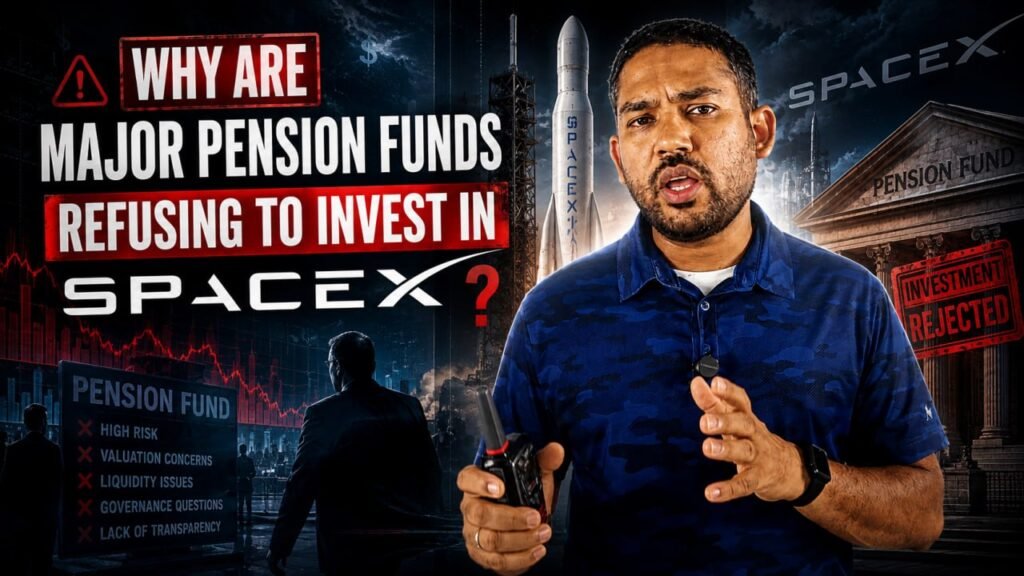
The Real Truth Inside the $1.75 Trillion SpaceX IPO: An S-1 Deep-Dive
With the stock market hovering near all-time highs, the internet is generating unprecedented hype for what is being framed as the single greatest investment opportunity of our lifetime: the upcoming initial public offering (IPO) of Elon Musk’s SpaceX. On June 12, 2026, the company is scheduled to make its public debut on the Nasdaq under the ticker SPCX, seeking a historic fixed price of $135 per share to raise $75 billion.
But behind the breathtaking rocket launches and PR campaigns lies a 270-page SEC registration statement (the S-1 prospectus) filled with disclosures that every retirement saver, 401(k) holder, and retail investor needs to read before risking their hard-earned capital.
Below is the unvarnished breakdown of what the lawyers wrote in the fine print—and why some of the largest institutional pools of money in the world are walking away entirely.
Table of Contents
The Real Estate Metaphor: Understanding Valuation Multiple Traps
The Smart Money Plays: The Berkshire Hathaway vs. SpaceX Contrast
1. The Real Estate Metaphor: Understanding Valuation Multiple Traps
Imagine a real estate agent trying to sell you a single-family home. The agent demands you pay 100 times its current market value. When you point out how absurd the price is, the agent smiles and promises: “Don’t worry, thirty years from now, this house will probably be worth a generous twenty times what you are spending today.”
You would walk away instantly. You would think the agent has completely lost their mind.
Yet, as the mega-cap tech IPO lineup approaches, millions of everyday retail investors are preparing to execute that exact same math with their retirement portfolios. Whether looking at the upcoming listings of Anthropic, OpenAI, or SpaceX, investors are buying into forward-looking narratives that require flawless execution for decades just to justify the entry price on Day One.
2. Full Transparency: The Conflict and the Bias
Before evaluating the financial metrics, absolute transparency is required. Analysis of this IPO carries two major internal biases that must be weighed:
The Competitor Aspect: There is a direct competitive overlap with portions of SpaceX’s business ecosystem, meaning this data should be reviewed with a healthy grain of salt.
The Private Investor Aspect: Having participated as an early private investor in SpaceX years ago, shares were accumulated at a minor fraction of the current $1.75 trillion public ask.
There is an enormous structural gulf between acquiring a brilliant private company at a heavily discounted valuation, and chasing a hyper-hyped public asset at the absolute peak of a marketing cycle.
3. The Core Engine: Starlink’s Legitimate Success
It is impossible to dissect SpaceX without celebrating the sheer scale of engineering brilliance Elon Musk has achieved since 2002. The operational milestones disclosed in the S-1 are genuinely historic:
Launch Dominance: SpaceX is responsible for approximately 80% of all the material mass lifted into Earth’s orbit globally.
The Starlink Constellation: Over 10,000 active satellites orbit the planet, providing high-speed, low-latency connectivity across 164 countries.
Subscriber Scale: Starlink has officially crossed 10.3 million active subscribers, yielding $11.4 billion in standalone revenue on an incredibly strong 36.5% operating margin.
If SpaceX were purely a satellite telecom and launch business, it would stand as a highly efficient, highly profitable cash-generating machine. But the corporate structure changed drastically just prior to filing.
4. The Hidden Math: Massive Net Losses and AI Cash Burn
When companies cross from private operations into public listings, SEC regulations strip away narrative marketing and expose the raw GAAP (Generally Accepted Accounting Principles) data. The consolidated financials inside the prospectus paint a vastly different picture than the headlines suggest:
| Financial Metric | Reported Value (USD) |
| Full-Year 2025 Consolidated Revenue | $18.7 Billion |
| Full-Year 2025 GAAP Net Loss | -$4.94 Billion |
| Q1 2026 Net Loss (Single Quarter) | -$4.28 Billion |
| Accumulated Balance Sheet Deficit | $41.3 Billion |
The core driver of these accelerated losses is not rocket development—it is the massive cash burn of the newly absorbed AI infrastructure division (following the all-stock acquisition of xAI in early 2026).
In Q1 2026 alone, the AI infrastructure division burned an astronomical $7.7 billion in cash, while generating a mere $818 million in revenue. Over the trailing twelve months, the consolidated entity’s total capital expenditure and operational burn rate sits near $30 billion.
The Competitor Landlord Irony
To offset this staggering burn rate, the S-1 notes that SpaceX’s Colossus 1 data center secured a massive lease contract with Anthropic, charging them $1.25 billion per month. The deep irony? Anthropic creates Claude—the direct, primary AI competitor to Grok (SpaceX/xAI’s own native chatbot). SpaceX has been forced to act as a landlord to its direct rival simply to subsidize its hardware overhead because its proprietary AI applications are failing to capture meaningful consumer market share.
5. Governance Breakdown: Why Pension Funds Are Boycotting
While the mainstream financial media focuses heavily on the $1.75 trillion market cap, institutional managers are looking directly at corporate governance. The S-1 reveals an incredibly restrictive, founder-favorable share architecture:
SpaceX operates a dual-class share framework. The Class A shares sold to the public carry 1 vote per share. The Class B shares held by insiders carry 10 votes per share. Elon Musk controls 93.6% of all Class B shares, commanding 85% of the total voting power while holding roughly 42% of the actual equity.
Because of this, SpaceX has officially elected “Controlled Company” status under Nasdaq rules. This status legally exempts the corporation from standard protections, such as maintaining a majority-independent board of directors or utilizing independent compensation committees.
Mathematically, Elon Musk can only be removed from the company by Elon Musk.
This lack of checks and balances has triggered an unprecedented institutional revolt:
AkademikerPension, Denmark’s massive $25 billion public fund, has officially blacklisted the SpaceX IPO, citing “catastrophic governance structures.”
CalPERS (California Public Employees’ Retirement System) and the New York State Common Retirement Fund have issued formal joint objections, warning that this is the most hyper-management-favorable structure ever presented to modern public markets.
To Elon Musk, SpaceX is his baby—and he is maintaining absolute custody. If the public investors funding the multi-trillion-dollar entity are locked out of basic voting rights, standard legal recourse (due to mandatory binding arbitration clauses in the bylaws), and operational oversight, the foundational principle of public equity is completely broken.
6. The Smart Money Plays: The Berkshire Hathaway vs. SpaceX Contrast
To find perspective on how to allocate capital rationally, look at what the most disciplined value investors on earth are choosing to do with their money right now.
While the retail market prepares to chase SpaceX at roughly 100 times trailing sales while it burns $30 billion annually, Warren Buffett’s Berkshire Hathaway just executed a massive $10 billion private placement into Google (Alphabet).
Google is currently executing its own landmark $80 billion capital raise to construct generational AI data centers. The contrast between the two allocations is stark:
Alphabet (Google) Multiple:   ~11x Trailing Sales  ---> Generating Predictable GAAP Profits
SpaceX (SPCX) Multiple:       ~100x Trailing Sales ---> Burning $30 Billion Net Annually
Berkshire Hathaway deliberately chose a highly profitable, 11x sales compounder over a highly speculative, 100x sales narrative. For SpaceX to simply justify its day-one $1.75 trillion public value, it would need to grow its revenue ten times over ($200 billion) while completely reversing its multi-billion-dollar operational deficit.
7. A Personal Conclusion: Navigating the Tech IPO Super-Cycle
As many of you who follow my work know, we recently welcomed a beautiful newborn child into our home. I am actively taking time away from a demanding business schedule to slow down, stay grounded, and prioritize spending precious moments with my kids.
I don’t make a habit of micro-analyzing individual ticker symbols or day-trading macro trends. But sitting at home and watching the massive, manufactured excitement being spun by corporate PR agencies, I felt an obligation to my community.
Spacex is simply the first domino in a massive, consecutive IPO wave that will soon include OpenAI and Anthropic. As those companies file their official S-1 documentation over the coming months, I will continue to pull the legal footnotes, bypass the media headlines, and present the unvarnished mathematical truth right here for free.
Do not let emotional fear of missing out (FOMO) dictate your family’s financial future. Prioritize your foundational retirement accounts, protect your capital, respect valuation metrics, and practice absolute patience.