
Inflation Just Hit 4.2%: Why Raising Prices Could Be the Wrong Move for Your Business
🎥 Watch the Full Video Analysis- CLick Here
Table of Contents
The Inflation Number Everyone Is Talking About
What Actually Caused the Inflation Spike?
Why Business Owners Should Pay Attention to Energy Costs
The Dangerous Mistake Many Businesses Will Make
Four Ways Smart Businesses Are Responding
What This Means for the Rest of 2026
Main Street Hustler Takeaway
Frequently Asked Questions
The Inflation Number Everyone Is Talking About
The latest Consumer Price Index (CPI) report has business owners asking a familiar question:
“Should I raise my prices?”
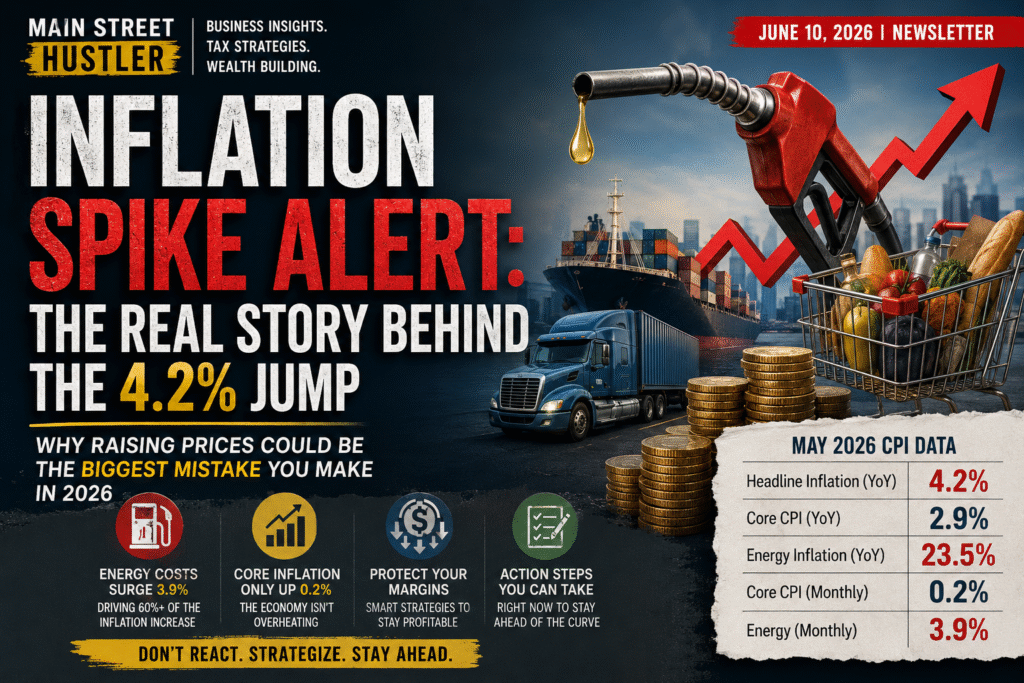
According to the latest data from the Bureau of Labor Statistics, annual inflation has climbed to 4.2%.
That’s a significant jump from the relatively stable inflation levels businesses had been getting used to over the past several months.
At first glance, the headline seems alarming.
Higher inflation usually means higher costs.
Higher costs often lead to lower profits.
And lower profits usually trigger price increases.
But this time may be different.
The headline number tells only part of the story.
When we look deeper into the data, we discover something most business owners are missing.
What Actually Caused the Inflation Spike?
Many people assume inflation is rising because consumers are spending aggressively.
The latest numbers suggest otherwise.
A large portion of the inflation increase came from one category:
Energy.
Energy prices rose sharply during May and became one of the largest contributors to the overall inflation increase.
Meanwhile, Core CPI—which excludes food and energy—showed only modest growth.
That distinction matters.
A lot.
Because it tells us the economy is not necessarily experiencing widespread inflation across every category.
Instead, businesses are dealing with a concentrated cost shock coming primarily from energy-related expenses.
Why Business Owners Should Pay Attention to Energy Costs
Energy affects nearly every business regardless of industry.
Think about it.
Fuel powers delivery vehicles.
Electricity runs offices and warehouses.
Transportation moves inventory.
Manufacturers depend on energy-intensive equipment.
Restaurants operate refrigeration systems.
Service businesses travel to customer locations.
Even accounting firms and professional service providers pay utility costs every month.
When energy prices rise, the effects ripple throughout the entire economy.
This creates pressure on profit margins even when customer demand remains relatively stable.
The Dangerous Mistake Many Businesses Will Make
When expenses increase, many business owners immediately decide to raise prices.
That reaction is understandable.
But it may not be the best strategy today.
Consumers are already dealing with years of higher housing costs, food costs, insurance premiums, and borrowing costs.
Their budgets are stretched.
Passing every additional expense directly to customers can lead to:
Customer churn
Lower sales volume
Increased competition
Reduced customer loyalty
Slower growth
The goal is not simply to protect margins.
The goal is to protect margins while maintaining customer relationships.
That’s a very different strategy.
Four Ways Smart Businesses Are Responding
1. Renegotiating Vendor Agreements
Many supplier contracts contain fees that can be challenged or renegotiated.
Review shipping agreements.
Review fuel surcharges.
Review payment terms.
Small changes can create meaningful savings.
2. Reducing Operational Waste
Before raising prices, examine internal inefficiencies.
Look for:
Excess utility usage
Inefficient delivery routes
Underutilized equipment
Unnecessary subscriptions
Travel expenses
The cheapest dollar is the dollar you never spend.
3. Adjusting Prices Strategically
Instead of increasing every price, consider:
Premium products
Specialty services
Low-volume offerings
Custom projects
Targeted pricing changes often produce better results than broad increases.
4. Protecting Cash Flow
Interest rates remain elevated.
Capital remains expensive.
Businesses with stronger cash reserves will have more flexibility if economic conditions worsen.
Now is a good time to revisit cash flow projections and contingency plans.
What This Means for the Rest of 2026
The biggest question facing economists is whether energy-driven inflation remains isolated or spreads into other areas of the economy.
If energy prices stabilize, inflation pressures could moderate.
If energy costs continue climbing, businesses may face additional challenges during the second half of the year.
Regardless of what happens next, business owners should avoid making decisions based solely on headlines.
The businesses that consistently outperform their competitors are usually the ones that understand the details behind the numbers.
D2 Tax Takeaway
Most business owners will see inflation at 4.2% and immediately think about raising prices.
The smartest operators will ask a different question.
“What costs can I eliminate before I ask my customers to pay more?”
That simple shift in thinking may be the difference between protecting your margins and losing market share.
Inflation creates challenges.
But it also creates opportunities for businesses that adapt faster than their competitors.
Frequently Asked Questions
Should every business raise prices when inflation rises?
No. Businesses should first evaluate whether the inflation increase is temporary, localized, or industry-specific before making broad pricing decisions.
Why is energy inflation so important?
Energy affects transportation, manufacturing, utilities, logistics, and daily operations across almost every industry.
What is Core CPI?
Core CPI removes food and energy prices to provide a clearer picture of underlying inflation trends.
How can small businesses protect margins without raising prices?
Renegotiating vendor contracts, reducing waste, improving efficiency, and optimizing operations can often offset rising costs.
Will interest rates fall soon?
Current inflation trends suggest rate cuts may remain delayed until inflation shows stronger signs of cooling.
What should business owners watch next?
Energy prices, future CPI reports, Federal Reserve policy decisions, and consumer spending trends.
Failure Mode Box
This strategy may not work if:
Your business operates on extremely thin margins.
Energy is your largest direct expense.
Vendor increases have permanently changed your cost structure.
You are already operating at peak efficiency.
In those situations, selective price increases may be unavoidable.
Enjoyed this breakdown?
Subscribe to the Main Street Hustler YouTube channel for weekly business insights, tax strategies, economic updates, and real-world lessons designed specifically for small business owners.