
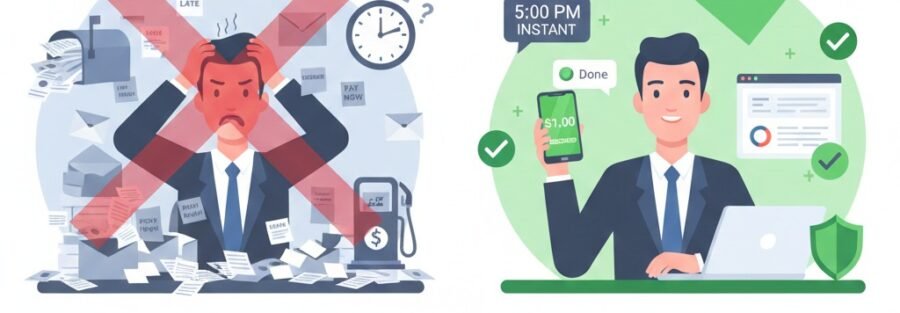
Checks Are Costing You Money: Why Paper Payments Drain Small Business Efficiency
I just found $2,000 in checks sitting in our mail. For weeks.
As a small business owner running D2Tax, an internet service provider, and multiple rental properties, I’ve tried everything to make payment collection more efficient. We offer ACH, Zelle, online bank transfers, credit card merchants—all the electronic methods that make life easier.
But here’s the problem: I can’t eliminate paper checks completely. There’s always that one tenant who insists on mailing a check. That one contractor who says, “I don’t do Venmo.”
So the real question isn’t how to eliminate checks entirely. The question is: How do you minimize the damage they cause to your efficiency, your time, and your security?
Table of Contents
- The Seven Problems with Paper Checks
- The Vacation Trap
- Security Risks Nobody Talks About
- How to Help Customers Switch to Electronic Payments
- My Wake-Up Call
- The Hidden Cost of Accepting Checks
- Common Pushback (And How to Handle It)
- What to Do This Week
The Seven Problems with Paper Checks
Let me walk you through what just happened. We closed the office for holidays. Family time. Normal stuff. Came back. Went through mail. $2,000 in checks sitting there. For weeks.
The kicker? I was actually LOOKING for one of these checks a month ago. Customer said they mailed it. Never showed up. I’m checking the mail every day. Nothing. Now it shows up when I’m NOT expecting it. When I’m on vacation.
That’s paper checks for you. But that’s just the START of the problems.
Problem #1: The Delay
Someone mails a check. Takes 3-4 days to arrive. Then it sits until someone can deposit it. Then it takes another 2-3 days to clear. That’s a WEEK minimum. Just to move money from one account to another.
Problem #2: You Need Someone You Trust with Your Bank Account
To deposit checks, someone needs login access to your bank. Usually that’s you—the business owner, the landlord. But what if you’re gone? What if you’re working in the field? Now you’re either stuck doing it yourself or trusting someone else with your banking credentials.
Problem #3: Checks Get Forgotten
I cannot tell you how many times I’ve found checks in my car. In the visor. In the glove compartment. Sitting there for MONTHS. In a few cases, I didn’t even deposit the check at all because by the time I found it, it was too late.
Think about it—I used to work in the field. You finish a job site 2 hours from home. You’re not worried about depositing a check. You’re worried about getting home. Getting something to eat. You had a long day. By the time you get home? You forgot all about the check. It sits there. And sits there. For months. It’s true. It happens.
Problem #4: Checks Bounce
Sometimes the check bounces. Now what? You call the customer. “Hey, your check bounced.” They get defensive. “No it didn’t! Check your deposit!” Now you’re in an argument. Meanwhile, you’re out the money AND the time.
Problem #5: Money Orders Are Even Worse
At least with checks you can mobile deposit. Money orders? Most banks won’t even let you deposit them unless you physically go to a branch location. Why? Who knows. But now you’re making a special trip to the bank just to deposit one money order.
Problem #6: Lost in the Mail
God forbid a check gets LOST in the mail. “I mailed it!” “We never got it!” Or it shows up a month later when you’re NOT expecting it anymore. Now you’re trying to figure out: Did they actually mail it? Did the post office lose it? Is it sitting in a pile somewhere? Good luck getting them to write another check. They already paid once (in their mind).
Problem #7: Mailbox Gets Too Full
Here’s one people don’t think about until it happens to them. You go on vacation. Or you’re just busy. Mail piles up. Your mailbox gets full. Now what? The post office STOPS delivering. They take your mail—including checks—BACK to the post office. Now you have to physically go pick it up. During their business hours. Which might be when you’re working. And your tenant? They have NO IDEA their check got sent back. They think you got it. You’re wondering where it is. Meanwhile, it’s sitting at the post office waiting for you to come pick it up.
These are REAL problems. And they happen all the time.
The Vacation Trap
All of this gets WORSE when you try to take a vacation.
You’re gone for two weeks. Checks are piling up. Your tenant texts: “What time can I drop off the check?” Now what?
You need someone to babysit that check. Pick it up. Deposit it at the bank. But here’s the question: How many people do you have around you that you’re okay giving your mailbox keys to? How many people do you trust with access to deposit checks into your bank account?
If you have immediate family or a close friend? Great. You’re lucky. They’ve got your back. But good luck if you don’t. Now you’re calling people you don’t really want to involve, but you have NO CHOICE. You HAVE to call for help. Because you’re busy. Or you’re not around.
And here’s the crazy part: The amount of money you’ll get is the SAME whether it’s electronic or a check. $1,000 is $1,000.
But the physical check costs you:
- A bank trip
- Involving someone else you’d rather not involve
- Your time. Their time.
- Your stress.
For the exact same amount of money. Why would you do that to yourself?
Security Risks Nobody Talks About
Every check has:
- Account number
- Routing number
- Address
- Signature
Someone deposits it. Then that physical check goes… somewhere. Trash can. File cabinet. Back of their truck. Your account information is on a piece of paper that you no longer control.
Same thing when YOUR customers write YOU checks. Their info is now on paper. In your office. In your car. What happens if you lose it? What happens if someone finds it?
With electronic payments? Everything’s encrypted. Nobody’s account info is sitting on physical paper anywhere. Much safer for everyone.
How to Help Customers Switch to Electronic Payments
Here’s what I started doing. And it’s made a HUGE difference. I help people set up electronic payments.
I know what you’re thinking: “Dhiren, I’m not tech support.” I get it. But here’s the thing: Spending 5 minutes helping a tenant set up Zelle saves you HOURS over the next year. No more waiting for checks in the mail. No more “what time are you at the office?” No more wondering if they sent it.
My Four-Step Process
Step 1: Offer Electronic Payment First
When someone new signs up—tenant, customer, whatever—I offer electronic payment FIRST. “Here’s how we prefer to receive payment: Zelle, ACH, online portal. Which one works for you?” Don’t even mention checks as an option unless they ask.
Step 2: Help Them Set It Up
If they say, “I don’t know how to do that”—I HELP THEM. “No problem! Do you bank with Chase? Wells Fargo? Let me walk you through it real quick.”
Most banks have Zelle built in now. Takes 2 minutes to set up. I literally do it on a video call with them. “Open your banking app. Click here. Enter my email. Done. Now try sending $1 as a test.” Boom. They’re set up. Forever.
Step 3: Explain the Benefits to Them
For people who are really resistant, I explain the benefits to THEM. “Look, with electronic payment:
- You get instant confirmation
- No wondering when the check will clear
- No waiting in line at the post office
- No buying stamps
- You can pay from your couch at midnight if you want”
When you frame it as making THEIR life easier? Most people come around.
Step 4: Make It Easy
We set up an online payment portal. They get a link. Click. Enter card or bank info. Pay. Done. We send them a reminder email on the 1st: “Payment due. Click here to pay.” One click. That’s it.
The easier you make it for them, the more likely they are to use it.
My Wake-Up Call
You know when I finally decided to fix this? I was cleaning out my truck. Found a check in the glove compartment. $850. From a customer. Six months old.
I called them. “Hey, uh… I found your check. I never deposited it.” They were NOT happy. “What?! I paid you six months ago!” And they were right. From their perspective, they DID pay me. They wrote the check. Handed it to me. Done.
But I put it in my glove compartment after a long day in the field and completely forgot about it.
That was the moment I realized: This system is BROKEN. It doesn’t work for me. It doesn’t work for them. I can’t keep track of physical paper while I’m running a business.
So I started helping people switch to electronic. And you know what? Most of them were RELIEVED. They didn’t want to deal with checks either. They just thought they had to.
The Hidden Cost of Accepting Checks
Here’s the thing people don’t realize: You’re getting the same amount of money either way. $500 rent? It’s $500 whether they Zelle it or mail a check.
But look at the difference:
With a Check:
- Wait 3-7 days for it to arrive and clear
- Find someone you trust to handle it if you’re gone
- Give them your mailbox keys
- Give them bank access or physically go yourself
- Hope you don’t forget it in your car
- Hope it doesn’t bounce
- Hope it doesn’t get lost in the mail
With Electronic Payment:
- They pay. You get it. Done.
- Doesn’t matter if you’re in town or in Thailand
- No one else needs to be involved
- Instant confirmation for both of you
Same money. Totally different experience.
And here’s the part nobody talks about: It’s not like you’re going to NET any extra money when you accept paper checks. You’re not. But you ARE paying more to accept them.
Your time driving to the bank. Your gas. Your stress. Paying someone else to handle it when you’re gone. That part’s almost hidden. We never pay attention to it. But as a small business? That’s just one more thing that drains you. One more inefficiency that adds up over time.
Common Pushback (And How to Handle It)
“My customers are older. They don’t do technology.”
Look, if they can text you asking what time you’re at the office, they can use Zelle. Most banking apps have it built in. Show them once. 5 minutes. They’re set forever.
“What about money orders?”
Oh, you mean the payment method that you can’t even mobile deposit? The one where you have to physically go to a bank branch? Yeah. That’s WORSE than checks. Help them switch to electronic even faster.
“What if the payment bounces electronically?”
It’s way easier to track and resolve than a bounced check. With electronic, you know immediately. With a check? You might not find out for a week. And good luck getting them to write another check after the first one bounced.
“I don’t have time to teach everyone.”
You know what takes MORE time?
- Driving to the bank to deposit checks and money orders
- Digging through your car looking for checks you forgot
- Calling customers when checks bounce
- Dealing with “did you get my check?” phone calls
5 minutes teaching them saves you HOURS.
What to Do This Week
Here’s your homework: This week—help ONE person set up electronic payment.
One tenant. One customer. Just ONE. Walk them through it. 5 minutes on the phone. Show them how easy it is. Next time they need to pay? It happens automatically. No checks. No mail. No waiting.
That’s it. You don’t have to convert everyone overnight. Just start with one. Then next month, help another one. Before you know it, you’ve gone from 20 checks a month to 2. And THAT’S where your freedom is.
Worth it? Absolutely.
Key Takeaways
- Paper checks create 7 major problems: delays, security risks, forgotten deposits, bounced payments, mail issues, and operational hassles
- You receive the same amount of money electronically or by check, but checks cost you significantly more in time, stress, and resources
- Helping one customer set up electronic payment takes 5 minutes but saves hours over time
- Most customers are relieved to switch—they just didn’t know it was easy
- Electronic payments provide instant confirmation, better security, and complete location independence
FAQ
How long does it take to set up electronic payments for customers? Most electronic payment methods like Zelle take about 2-5 minutes to set up. You can walk a customer through it on a single phone call, and once it’s set up, it works forever.
What if my customers don’t have smartphones or use online banking? If they can text you or check email, they likely have the capability for electronic payments. Most major banks have Zelle built directly into their banking apps. For truly technology-resistant customers, consider setting up an online payment portal they can access from any device.
Are electronic payments more expensive than accepting checks? No. The hidden costs of checks (your time, gas for bank trips, stress, potential bounced check fees, and paying others to help) often exceed any small processing fees for electronic payments. Many electronic options like Zelle and ACH transfers are free.
What happens if an electronic payment bounces? You know immediately when an electronic payment fails, unlike checks where you might not find out for a week. Electronic payment failures are easier to track and resolve, and you can address the issue right away instead of days later.
How do I convince older customers to switch to electronic payments? Focus on the benefits to them: instant confirmation, no trips to the post office, no buying stamps, ability to pay from home at any time. Frame it as making their life easier, not yours. Most people appreciate convenience once they understand how simple it is.
What’s the best electronic payment method for small businesses? It depends on your business, but Zelle, ACH transfers, and online payment portals are popular because they’re either free or low-cost and easy for customers to use. Many banks have Zelle built in, making it the easiest starting point.
What should I do with customers who absolutely refuse to use electronic payments? Keep the option available but make electronic payment your default and primary recommendation. For the few who truly can’t or won’t switch, establish a clear process for check handling that minimizes your involvement and risk.
We’re still paying EXTRA just to collect the same amount of money. You’re not making more by accepting checks. But you’re definitely spending more—your time, your gas, your stress, paying other people to help.
Most people don’t WANT to mail checks. They just don’t know there’s an easier way. Or they think it’s complicated. Show them it’s easy? They’ll switch. And when they do, everyone wins. They get convenience. You get freedom. And you stop draining your business with hidden inefficiencies.
Help one person set up electronic payment this week. Just one.